


































Courtesy Warren Schafer
As Halloween wraps up and cold temperatures continue to sweep across the region, local ski resorts are wasting no time preparing for the fast-approaching winter season. Many underestimate the monumental effort required to operate a ski area; it takes weeks of teamwork, manual labor, and strategic planning to ensure everything is ready for opening day.
A critical part of this process, and arguably one of the most important, is snowmaking﹘ the process that transforms grassy hills into a winter wonderland. Snowmaking crews at Liberty, Whitetail, and Roundtop are starting their preseason training, equipment inspections, and monitoring weather patterns as they gear up for the long, cold nights ahead.
What is Snowmaking?
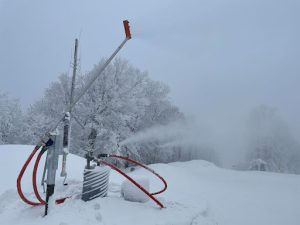
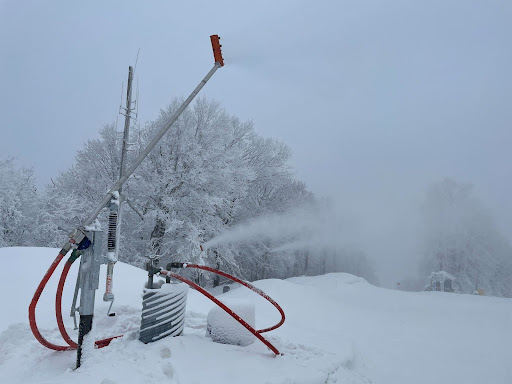
Snowmaking is the process of combining high-pressure water and compressed air to create a nucleated stream of ice crystals that bond and freeze to other water droplets to create man-made snow!
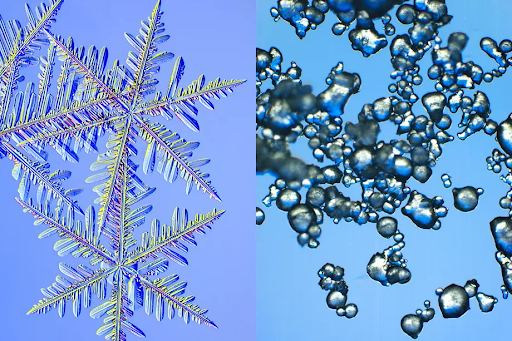
In fact, the process of making snow mirrors the process of natural snow. In nature, snow is formed when moisture in clouds freezes around tiny particles of dust or pollen. The frozen crystals then fall to the ground as snowflakes, each with a unique crystalline structure.
Courtesy Kenneth G. Libbrecht
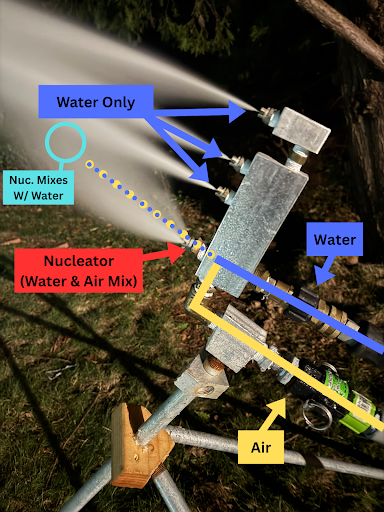
Man-made snow follows the same principles as natural snow, but is applied in an engineered way. High-pressure water is sprayed from small nozzles, creating a fine mist. At the same time, compressed air and water are mixed inside a small chamber. The compressed air expands rapidly, shattering the water stream and creating microscopic droplets that instantly supercool. This process, called nucleation, is the formation of the first ice crystals—tiny “seeds” of ice that the larger droplets bond and freeze around. These nuclei act as the dust or pollen found in nature, providing a frigid surface for surrounding water droplets to crystallize on. Without proper nucleation, the snowgun produces slush or ice, rather than dry snow. When the proper mix between nuclei and water is reached, each droplet freezes into a small, round “snowball”, rather than a unique snowflake—like Dippin’ Dots, but much smaller and not ice cream!
Courtesy Warren Schafer
Besides the engineering behind snowguns, the process relies heavily on temperature and humidity, which together create the wet-bulb temperature, a measure of how cool the air feels after factoring in moisture, essentially evaporative cooling. For snow to form, the wet-bulb temperature generally needs to be 28℉ or lower. Even if the air temperature is above freezing, low humidity can still allow for snowmaking to occur. Check out the real-time wet-bulb snowmaking forecast for Thurmont!
Preparations Behind the Scenes
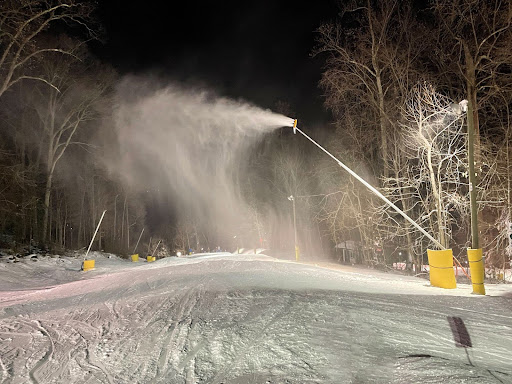
For resorts in our region that see less than 20 inches of natural snow each year, a well-oiled and reliable snowmaking system is crucial. Each season, crews inspect every nozzle for clogs or wear, test the massive pumps required to move thousands of gallons of water per minute, and run the air compressors essential for nucleation at each snowgun, among many other tasks.
Alongside maintenance, new hires are trained in safe snowmaking procedures, and warm-weather tests are performed to ensure the system is running properly and ready for any freezing temperatures in the future.
Courtesy Warren Schafer
These dedicated teams often go unrecognized, but their passion, camaraderie, and drive to produce the best quality snow for guests are appreciated by thousands every day.
At this time no opening date has been set for Liberty, Whitetail, or Roundtop, but historically, the goal is December 20th. If you haven’t waxed your skis or board yet, it’s time to dust off the gear—winter is almost here.